Joel Kline
Slow BurnJoel Kline is an FBI agent whose role in the investigation is marked by a useful tension: he can be accommodating to Dylan Buchanan while remaining wary of a case that seems too neatly solved. His skepticism is practical rather than abstract. When laboratory results connect Ewan MacKenna to fingerprints on a calendar, Kline reopens the possibility that the apparent crime scene was staged, turning a tidy collection of clues into a fresh investigative problem.
Identity and Introduction
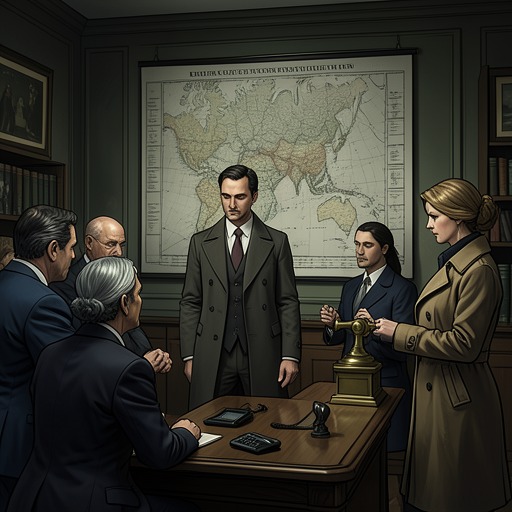
Kline is introduced as the agent in charge of an FBI presence described as being there in force. He is about Dylan Buchanan’s age, but his appearance suggests a professional life shaped by repeated exposure to crime scenes: deep creases mark the corners of his mouth, and his tall, thin frame is hunched at the shoulders, as if from prolonged stooping. These details establish him as experienced without supplying a formal career history. His first defining action is interpersonal: despite his authority, he proves surprisingly accommodating.
That accommodation does not mean that Kline accepts other people’s conclusions without scrutiny. The contrast between his approachable manner and his attention to how evidence has been presented gives his character a clear investigative function. He can work with Dylan, but he does not simply adopt Dylan’s reading of events; he tests the apparent order of the case against the possibility of deception.
Suspicion and the Calendar Evidence
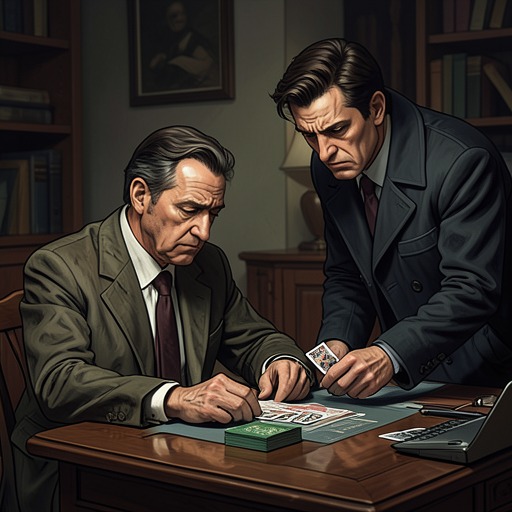
Kline’s doubts become explicit when the papers and clues seem almost excessively well arranged. He objects to the impression that everything has been laid out for investigators, even to the point where the evidence might as well have arrows pointing toward it. To him, that kind of neatness is not reassuring. It raises the possibility that someone has staged the scene to direct attention toward a particular interpretation.
The suspicion remains a possibility, not a conclusion, until new information arrives from the laboratory. Kline reports that fingerprints on the calendar match Ewan MacKenna. The result changes the investigative picture: rather than merely endorsing the apparent trail, Kline acknowledges that Dylan may be right about staging and describes the result as opening up a new problem. The sequence matters. His skepticism first questions the presentation of the evidence; the fingerprint result then supplies a concrete reason to reconsider what the scene means.
Kline’s response also shows how his judgment can change with evidence. He does not insist on his first position once the laboratory finding complicates it. Instead, he accepts that the scene may have been staged and recognizes that the investigation must widen to account for that possibility. The calendar therefore functions both as physical evidence and as a test of Kline’s method: a match identifies a connection, but it does not by itself settle what the scene was designed to suggest.
Coordination with Dylan Buchanan
Kline’s working relationship with Dylan becomes more urgent after Kate MacKenna disappears. Dylan has just absorbed the news when a car stops outside the building. Kline had said he would meet him at Smith and Wesson, but he stays in the car and pounds on the horn rather than coming inside. The action makes the meeting an immediate response to events, not a routine appointment; the evidence does not specify what Kline knows about the disappearance at that moment.
When they reach the gated area, Kline urges Dylan to get inside while continuing to look. He spots Vanessa MacKenna to the right and tells Dylan to let him handle her. This is a concise division of responsibility: Kline takes charge of the interaction with Vanessa while directing Dylan’s attention to the immediate situation. It shows him operating as an agent in the field, coordinating with Dylan under pressure rather than merely discussing evidence after the fact.
Vanessa MacKenna and the Unresolved Case
Dylan predicts that Vanessa will give Kline up and points out that she is watching him with visible hostility. He argues that once she understands what she is facing, she will deal. This is Dylan’s assessment, not a confirmed outcome: the available account does not establish that Vanessa confesses, identifies someone, or cooperates. Kline’s instruction to handle the encounter himself nevertheless places him at the center of the next investigative step.
Across these scenes, Kline is defined less by a personal history than by how he works: he listens, questions a scene that appears too convenient, updates his assessment when a fingerprint match arrives, and takes responsibility for a consequential encounter. The evidence leaves the result of that encounter open, but it establishes the character’s importance in the investigation’s movement from suspiciously orderly clues toward a more complicated inquiry involving Ewan, Vanessa, and Kate’s disappearance.